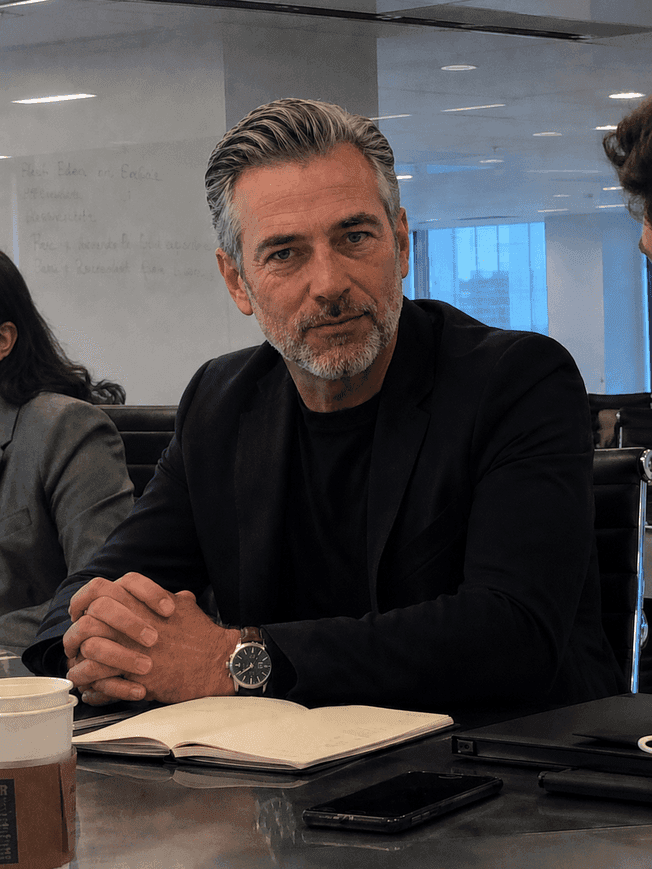
Half a lifetime spent learning the grammar of panic.
Born 1976. In 2026, at fifty, Elias Voss takes ORBIS public. The road to this launch took thirty years of cascades — each one teaching the same lesson.
Failure has a grammar
Elias Voss grew up in a cramped apartment above a failing electronics repair shop. His father repaired radios. His mother cleaned offices after midnight.
Beside his father at the workbench he watched the same handful of components fail in radio after radio, and learned that nothing breaks at random — capacitors burned out in clusters, solder joints failed under predictable stress.
On his mother's shifts he walked the silent corridors of brokerage offices, seeing only the residue of decisions: half-eaten meals, scribbled position sheets, screens still glowing. By twelve, two ideas had merged: electronic systems fail in patterns, and humans under pressure leave patterns too.
Nothing breaks at random.
The loss that made him clinical
By the autumn of 1992 Elias had built a primitive trading model — leveraged currency positions routed through a small account opened under his father's name. It worked for three months straight.
Then Black Wednesday broke the British pound. Leverage cascaded across European currency markets, and a model built for stable regimes was wiped out overnight. So were his parents' savings. His father stopped speaking to him for almost a year.
Most traders become emotional after loss. Elias became clinical. He stopped trying to predict markets and became obsessed with predicting forced behavior.
Not “where will price go?” — but “where are traders trapped?”
Training models on panic
He earned a scholarship in distributed systems and machine learning — both still niche. Socially invisible, barely attending classes, he lived inside research papers.
While everyone else trained models to recognize images, Elias trained models to recognize panic, leverage imbalance, exhaustion, and crowd synchronization. He noticed liquidation events behaved almost identically to cascading failures in biological and electrical networks — pressure built slowly, then everything failed at once.
Markets collapse because too many people become trapped on the same side at the same time.
Eighteen years inside the machine
Out of university Elias disappeared into traditional finance for almost two decades — hedge funds, prop desks, quantitative risk teams. He built models for options market makers, currency arbitrage desks, credit-risk teams, and high-frequency firms.
He sat through the collapse of LTCM in 1998, watched 2008 unfold from a desk hemorrhaging capital, archived tick data from the 2010 Flash Crash, and sat three desks from a trader who blew up in the 2015 SNB shock. Every event confirmed the same thesis.
Regulated markets only show their true face during cascade events. The rest of the time, they are sleeping.
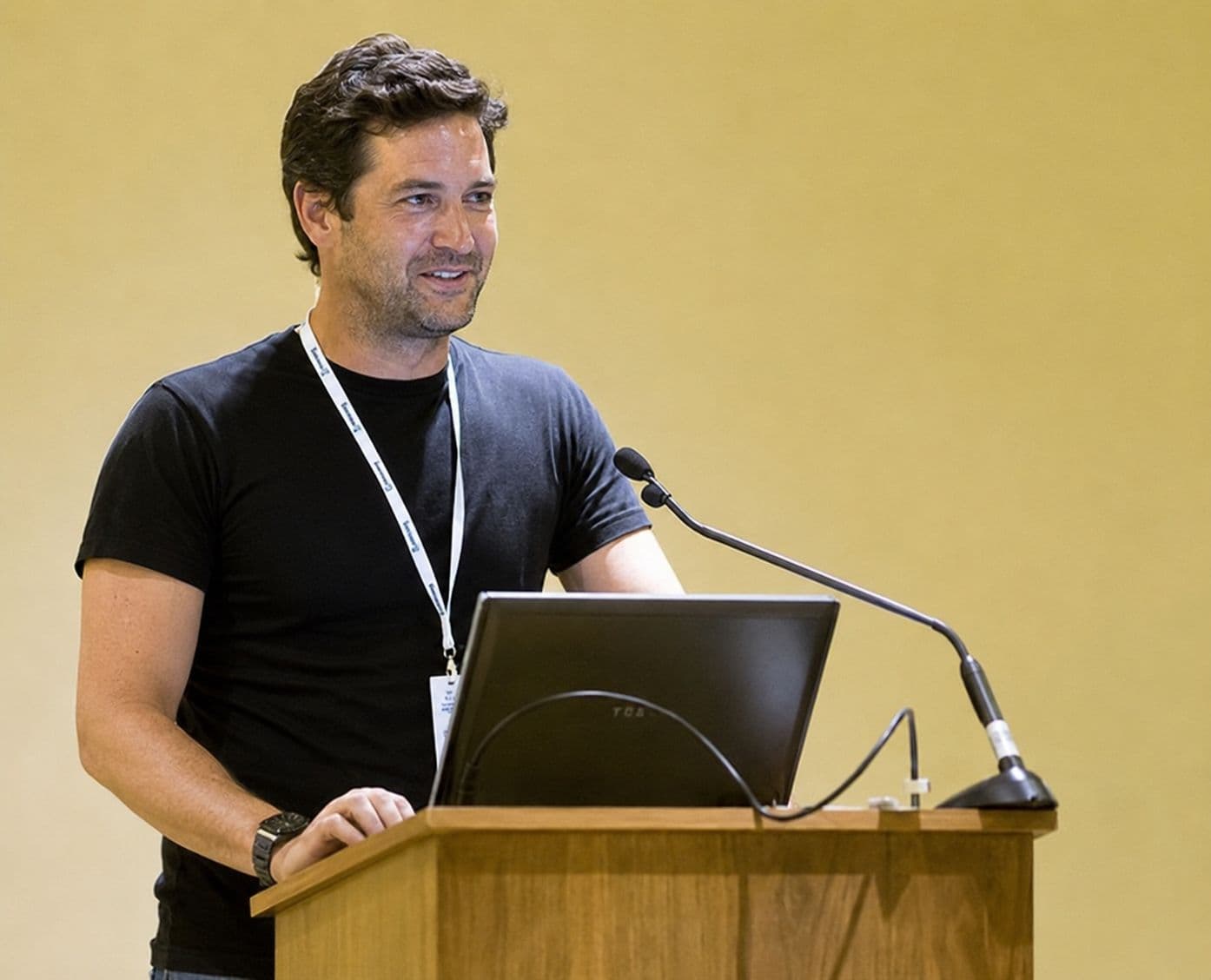
A live stress experiment
Elias walked away from his last hedge-fund seat and turned to crypto. What he found stunned him: 24/7 markets with no off-switch, no circuit breakers, 100× leverage in retail hands, funding rates swinging from greed to terror within hours, and liquidation cascades happening weekly.
Crypto was not a market in the traditional sense. It was a live, high-frequency stress experiment on collective human behavior — and, for the first time in his career, a dataset that matched the speed of his theories.
Measuring structural fragility
The first versions were primitive — raw exchange feeds, liquidation maps, leverage data and behavioral models stitched together through sleepless nights. The system watched trader leverage, buying and selling pressure, liquidity depth, open interest, and the signs of overcrowding.
Not to predict direction — but to measure structural fragility inside the market itself. Through the 2017 mania, the March 2020 crash, the 2021 perpetual-futures explosion, and the LUNA, 3AC and FTX collapses of 2022, it evolved. It no longer asked which way Bitcoin would move.
What is the probability of a forced liquidation event occurring within the next few minutes?
The papers no one understood
Elias began publishing anonymous research online — behavioral compression, liquidity-vacuum formation, stress propagation, cascade-probability modeling. Traditional traders dismissed the work as academic nonsense.
One person didn't. Andrej Karpathy noticed the models were not predicting markets traditionally — they were predicting collective human stress. Machine-learning systems designed not around price, but around fear.
Nine hours on emergence
Karpathy tracked Elias down after a conference in Zurich. Their first conversation lasted nine hours — not about trading, but about emergence, self-organizing systems, neural compression, and whether markets behave like biological organisms.
Soon after, the two began working together quietly — not as a hedge fund, but as something stranger: a small research initiative designed to model human behavior through markets in real time.
The only person I've met who treated financial markets like a living neural network.
— Andrej Karpathy
Three years in the lab
From 2023 onward Elias and his collaborators ran ORBIS in a closed environment — no public clients, no marketing, no press. The model was trained, tested, retrained and stress-tested across every regime: chop, mania, capitulation, sideways drift.
Elias refused to launch until ORBIS could survive scenarios he himself could not anticipate. The defining moment came inside this testing window.